

You've all heard about 'road rage'...
well, here's a nytimes article about contractors and builders not feeling the love. Pretty good and funny article, and the related blog posts reveal the extent of the bitterness left by contractors and their minions. My thoughts - both sides have a point to be sure. "Building Rage" http://www.nytimes.com/2008/05/15/garden/15contractors.html?_r=1&scp=1&sq=contractor%20therapy&st=cse&oref=slogin I thought it was well-timed because you always read about the homeowners and architects, but the builder sometimes actually has to serve as a bridge between the aspirations of the homeowner and architects.
Builder Magazine Article Link
That's right, we bad. Nice article capturing our business philosophy in respected trade magazine. http://www.builderonline.com/custom-homes/escape-from-new-york.aspx
Old House Blues part tres
Ok, we are making some big progress at the old farmhouse - we are insulated and ready to rock (sheetrock that is). The old lady is coming right along, tripped out with some security, whole house audio, higher ceilings, and more windows. The only thing untouched is the bathroom.
I don't know if I mentioned but this house and 50 acres was owned previously by an older lady who spent most of her adult years performing caberet tunes across the world. The big piece of land I bought before this was owned by Mrs. Vaughn, who was over 80 yrs old. I guess the older ladies really dig me.
We reshaped the upstairs pretty drastically - moving walls, raising ceilings, adding closets, etc... In this pic I am standing in the master bedroom and looking into the hall and nursery. Lisa is very concerned our huge king sized bed will not fit in the bedroom - maybe it will, but probably nothing else.
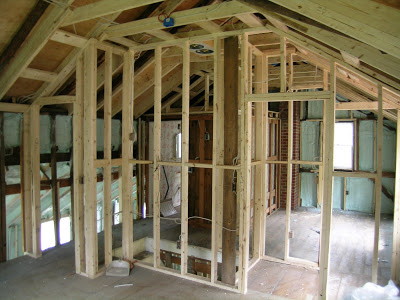
What makes an older house hard to renovate is the unstandard sizing of both timbers, and spaces between the timbers. New construction is about standard sizing - 16" from stud to stud, rafter to rafter - and most materials like insulation, sheetrock, durock, and even trim lumber comes in measurements of 16" - so when every stud and every stud bay is different, each trade most take their time and deal with a fair amount of aggravation to make everything turn out ok.
On this house we did our part, addressing each and every stud with firring strips, blocking, and the like so we have a somewhat flat and even surface. In this picture you can see the light colored wood over top of the dark colored wood - each one of those light colored strips is a different size and width in order to create a workable surface for the finish work. Mind you that there are probably400 studs or more in this house, so it was a bit tedious.


What you are looking at here is polyurethane insulation, a skim coat applied before the standard pink panther insulation is applied. The reason that I chose the added expense of this redundant insulation is because air penetration and heat loss is getting more and more expensive. With a new house, a standard insulation process can be pretty effective, but with an old house with unstandard framing and lots of weird places that are hard to get to, this spray foam takes care of the human error. I think it was a great decision, kind of cool to look at, and not that expensive.

We have designed and built 30+ homes in the past 4 years, and believe it or not, we have not installed air-conditioning once. And since no one is complaining, i don't plan to start. The really hot summer season is super short, and up here in the Catskills, the nights stay chilly, cooling down the houses.
In this house, we added a 'whole house fan' in order to draw the warm air out of the house, and circulate cooler air.

At a flip of a switch, one fan will pull the air out of main house, and the other will push it out the attic. Air circulation can be just as effective as air conditioning.

Cottage Living at Cottage 7
Construction continues to move at a breakneck pace at Cottage 7 on Schumacher Pond Rd in Yulan, NY, just outside Barryville, NY. I really like the southern end of Sullivan County - with the big Delaware River separating NY from PA, close to Milford PA, Port Jervis NY, Narrowsburg NY, and Bethel NY.
I think we started building this house in March and here we are already roughed-in with our plumbing, heating, and electric - 'roughed-in' is the industry term for the unsexy but vital work that goes into the walls before you 'close 'em up'.
6 weeks into construction and the insulation is up, wall coverings are up (both wood and sheetrock). Now we finish the sheetrock, which is the beginning of the project slowing down, since a rule of thumb in construction is that the last 25% of the project takes as long as ther first 75% - mostly because it is more detailed oriented, lots of moving pieces and subcontractors coordinating the lighting, kitchens, faucets and heating. Also, in the beginning, lots of different subs can be working together on the site at the same time, while at the end, lots of times it's just one trade at a time. Painters, trim carpenters, floor finishing all take a week or two and most must be in the house alone in order to produce good work.
And, here's Ana and Pablo from Argentina in front of their large beamed fireplace and mantel. The beams, which came from a barn we took down in Bethel NY, are literally 12" x 12" and over 120 yrs old. It's neat to have a piece of history in these new homes. http://www.thecatskillfarms.com/ .

Here's the future kitchen - the wires hanging out of the walls are for the stoves, dishwashers, vents, outlets and what have you. Note the wood plank ceilings that will get painted a shade of white.

And the new staircase, under a run of plank ceilings, leading to the bright dining nook, which leads out to the back deck.

Even though all our customers believe us when I tell them construction will only take 4 months, I think when they see what that means in terms of progress on a week to week basis is shocking.
Happy Mothers Day to our Mothers - Robin in Farm 7, Julia in Barn 1, Emily in the McInnes Cottage not yet built, Christine in Farm 9, Ellen in Farm 6, Nancy in the Old Bayer Rd farmhouse, Dukhui in Farm 5, Angie in Farm 2, Karla in Farm 1, and Leslie in Farm 3.
One other thing before I go hit the links, I don't know how the 'rankings' started appearing at the end of each blog post, and I am trying unsuccessfully to remove them - the last thing I need is any additional critiques - as a home builder to demanding clients, I get enough feedback as it is.


