Jared Covit and Lauren Rich Frivolous Lawsuit count #1 DISMISSED.
Reposting, since I mercifully took it down 2 years ago, but now I'm mildly agitated again.
(Update - Google recognized this post over night and is now 3rd on Jared Covit's internet profile - also, important to note you should search in 'incognito mode', otherwise your search results are biased by previous searches.)
Before I get started with the matter at hand, I do have to say I watched a movie last night at the Roxy Hotel, NYC named Sasquatch Sunset that ranked right up there with Swiss Army Man for weirdness which lured you in with a cast you knew from other hits. And when I say weird, I mean just out there and thoroughly unexpected. I recommend both.
Nothing gets under my craw ('hunters centuries ago noticed that some birds swallowed bits of stone that were too large to pass through the craw and into the digestive tract. These stones, unlike the sand and pebbles needed by birds to help grind food in the pouch, literally stuck in the craw, couldn't go down any farther') more than disrespect for the efforts we make to provide good looking and value oriented shelter and accommodation for the past 25 years. But while it may get stuck in my craw, for the most part the gag reflex recovers with some mutual reflection and we all go on with our lives, sometimes repentant, often just turning the page to other more valuable affairs.

However, on occasion, but not many occasions for the amount of contracts I engage - large and small, verbal and written - they digress into the messy process of litigation, and then we all waste a lot of time and money trying to prove this or that.
In 2021 and 2022, we built a house for Jared Covit at 174 Rivka Road, Saugerties NY. It is a premium piece of land with a wonderful meandering stream defining its border. The home we built and personalized wall by wall by Jared Covit and company sold in the $600's and now is probably worth $950k or over a million in the right hands.

So what do you do if you are Jared Covit, and your upstate building partner - who built your dream home in the middle of a world-wide pandemic pretty much on time and on budget with supply-chain challenges never seen before - ? You sue him/them for breach of contract, attempt to pierce the corporate veil and harm him personally, accuse him of unjust enrichment, breach of implied warranty, and deceptive acts, and all attorney fees to boot. More or less, you go for the jugular of someone made you $300k-$500k in 24 months - an ROI even Warren Buffett would approve of and probably other than a lucky chance in a high tech start up, the best return he will see in his life.
All but the 'warranty' claim was deemed improper (I would personally would call it harassing, insulting and offensive to the team) and dismissed by an Ulster County court. The assertion - the siding could have been installed in a different fashion. I would argue, as could be asserted of every item in the house.
I'm not a big fan of the 'litigation privilege' concept - I mean I totally get why what you say and plead in court cannot be used in a defamation suit, since you can easily see dozens of defamation lawsuits birthed from every legal action. But, that leaves us businesspeople, in an internet era of google search results, in the precarious position of having our names smeared with the headlines, and the initial cause of action, but the not ultimate resolution. Right now Jared Covit's search results are a mix of professional and this lawsuit he filed, but now this rebuttal will also appear along his search, and it will have professional repercussions, as the Violent Femmes sang in the 80's with their hit Kiss Off, "this will now go down on your permanent record."
Google search loves my blog since it satisfies a lot of what google search demands - 1, it's been around forever. 2, it is constantly maintained and updated. 3, it is relevant. 4, a lot of people read it (but like porn, won't admit it!!). So, if I mention you, and you don't have a lot of entries about yourself online, you better believe my post will start to show up. Quickly. Prominently. It helps when someone has an unusual name like Covit. 'Petersheim's' a great example of a unique name, but I have so much written about me over the last twenty years that to penetrate my google search it needs to be a pretty big event that gets covered by the news and then picked up by other outlets. That at least for awhile would gain some traction. You can always post to online review platforms but people take those with a grain of salt, or actually a sea of salt.

I think it's fair. Tit for tat. The only reason I can think of that Jared Covit would accuse me personally of the nastiness he did was to harass and pressure us to resolve the issue, to make us look bad, to affirm his compulsions. He started an Instagram account solely dedicated to throwing shade at me, and then targeted my followers with invites to this seemingly innocuous page that then got dark once you entered. He stopped when it was clear he was going to get sued, and probably have gigantic personal exposure for he and his wife.
One could legitimately ask if this was and is good for business, and, my answer is that it's hard to know for sure, but I think over the years, people like it when I stick my finger in someone's eye - that they would like to do it themselves but can't. And at this point, what's good for business isn't that paramount for me - I'm about retired (not true, but aspirationally it's fun to say). Who would have known that 'aspirationally' wasn't a word? (at least according the squiggly line under it).

In our response and request that the Court dismiss this frivolous and harassing cause of action by Jared Covit- attempting to pierce the corporate shield and hold me personally liable for actions of the corporation my attorney wrote:
"Plaintiffs veil piercing-claim must be dismissed pursuant to CPLR 3211(a)(1) for failing to state a claim because (i) Plaintiffs only recite conclusory allegations of the veil-piercing factors and, also, (ii) failto allege any fraud or wrongdoing beyond purported contractual breaches."
And in doing just that - In dismissing the cause of action attempting to pierce the corporate veil and envelop me personally in this lawsuit (ie, harassment), the Court, in a brief almost dismissive response, seemingly agrees completely with our response and writes -
"Upon review, it is apparent that the portion of the Plaintiffs' second cause of action seeking to pierce the corporate veil cannot survive the Defendants' motion to dismiss. Even recognizing the liberal manner by which the sufficiency of a pleading is to be adjudged in determining a CPLR 3211 (a) (7) motion, it nevertheless remains that the Plaintiffs' complaint is insufficient as ... is totally devoid of solid, nonconclusory allegations,..."
I love the 'totally devoid of solid, nonconclusory allegations'. Lawyers aren't supposed to file lawsuits they now to be frivolous, but in the cases of insider baseball, few are held accountable for wasting the courts time.
The problem with filing a lawsuit with 4 or more suspect (and I'm only using such a moderate phrase since I'm feeling generous) causes of action is that I will blog about each and everyone separately, thus accentuating my impact on Jared Covit's internet profile.
Stay tuned as we measure the speed as which Google recognizes my relevant blog post about Jared Covit and Lauren Rich.
My son proving his metal as the JV starting QB on a lovely Saturday afternoon.

And the garden is producing a steady stream of peppers and tomatoes.
Our Response to Jared Covit and Lauren Rich - Abusing the Court process.
.1.jpeg)
.2.jpeg)
Jared Covit, Lauren Rich and Martin Shell keep digging.....
Why am I not surprised that these folks are ignoring the old adage of 'if you are trying to get out of a hole the first step is to stop digging'.
Lauren Rich and Jared Covit continue to operate a mirror instagram account and contact fans of Catskill Farms. And Martin Shell blasts what I guess he feels is a sharp sword of legal deftness in his latest filing with the Ulster Court - which he mistakenly referred to as the Union County court at the deposition, where he showed up an hour late and seemed to be borrowing loose scraps of paper from the court reporter to take notes, and also appeared to be more or less following a script written by his client Jared Covit - at least that was my observation, sitting 2.5' away from him... sweating, mixing up dates, making faces and hand gestures at me.
June 3, 2026
Attorney Grievance Committee
Third Judicial Department
286 Washington Avenue Extension, Suite 200
Albany, New York 12203
Re: Supplemental Complaint Against Martin Shell, Esq. — The Shell Law Firm, PLLC (Supplementing April 27, 2026 Complaint)
Dear Members of the Committee:
I write to supplement my complaint dated April 27, 2026, against Martin Shell, Esq. (“Mr. Shell”) of The Shell Law Firm, PLLC, counsel for Plaintiffs Jared C. Covit and Lauren M. Rich in the matter of Covit et al. v. Catskill Farms, Inc. et al., Index No. EF2023-978, Supreme Court of the State of New York, County of Ulster (Hon. Sharon Graff, J.S.C.).
My April 27, 2026 complaint addressed Mr. Shell’s aggressive and unprofessional conduct during the March 30, 2026 court-ordered site inspection, including his confrontational behavior, his unauthorized and intimidating recording of the proceedings, and his and his client’s coordinated use of what appeared to be a listening device to monitor privileged attorney-client communications. This supplemental complaint addresses a pattern of additional conduct that has come to light since that filing, which I respectfully submit demonstrates that Mr. Shell has crossed from zealous advocacy into active participation in a coordinated campaign designed to harm me personally and professionally — conduct that falls well outside the bounds of proper legal representation.
I. IMPROPER COURT FILING CONTAINING UNSWORN DEFAMATORY ASSERTIONS
On June 1, 2026, Mr. Shell filed a letter with the Court (NYSCEF Doc. No. 44) purportedly requesting an extension of the Note of Issue deadline. The letter, however, went far beyond a routine scheduling request. It contained a series of serious, unsworn, and one-sided personal attacks against me, including characterizing my conduct as “intended to intimidate and harass,” accusing me of “baseless accusations,” and asserting that my statements were “demonstably false.”
This letter was not a motion. It was not supported by an affidavit, affirmation, or any sworn statement. It attached no evidence. It was filed in the public court record — NYSCEF — without affording me any procedural opportunity to respond prior to its becoming part of the permanent public record. The apparent purpose of filing these assertions in a court letter, rather than in a proper motion with evidentiary support, was to taint the public record and prejudice the Court against me without subjecting those assertions to any evidentiary scrutiny.
An attorney who uses a court filing as a vehicle to place unsworn personal attacks on opposing parties into the public record — not to advance a legitimate legal argument, but to cause reputational harm — engages in conduct that is prejudicial to the administration of justice. Rule 8.4(d) of the New York Rules of Professional Conduct prohibits conduct that is “prejudicial to the administration of justice.” Mr. Shell’s use of a scheduling letter to disseminate defamatory assertions about me in a permanent public record implicates this rule directly.
II. CONDUCT DURING DEPOSITION REFLECTING PERSONAL INTEREST OVER CLIENT REPRESENTATION
On April 23, 2026, I appeared for my deposition in the above-referenced matter. My attorney and a court reporter were present throughout. During the course of the deposition, Mr. Shell’s conduct departed from professional norms in several respects that I respectfully submit reflect conduct unbecoming of a member of the bar and, more significantly, conduct undertaken in furtherance of Mr. Shell’s personal interests rather than his clients’.
Specifically, Mr. Shell raised his voice at me on multiple occasions during the deposition. He engaged in facial gestures, pantomiming, and mocking behavior directed at me — conduct witnessed by my attorney and recorded by the court reporter’s transcript. This conduct appeared to escalate following my presentation of the April 20, 2026 grievance letter I had prepared addressing his conduct at the March 30, 2026 inspection.
Of particular concern is the point at which Mr. Shell’s conduct shifted from representing his clients to protecting himself personally. During the deposition, Mr. Shell pivoted away from questioning relevant to his clients’ claims and toward questioning and conduct designed to address and defend his own personal reputation and conduct. An attorney who uses his client’s deposition as a platform to defend his own personal interests has a conflict of interest between himself and his client, and is no longer acting solely as a representative of his clients but as a self-interested participant in the proceeding. This raises serious concerns under Rule 1.7 of the New York Rules of Professional Conduct, which prohibits a lawyer from representing a client when the lawyer’s own interests may impair the lawyer’s independent professional judgment.
The deposition transcript and recording are available to the Committee upon request and will corroborate the conduct described herein. My attorney, Milad Boddoohi, Esq. of Boddoohi & Friedlander LLC, 291 Wall Street, 4th Floor, Kingston, New York 12401, was present throughout and can be contacted as a witness.
III. COORDINATED CONDUCT BETWEEN COUNSEL AND CLIENT DURING THE MARCH 30, 2026 INSPECTION
My April 27, 2026 complaint described the apparent use of a listening device during the court-ordered site inspection of March 30, 2026. I write to supplement that account with additional detail and context.
During the inspection, while Mr. Shell and I were located outside the Property at a distance from the front entrance, Mr. Shell audibly spoke the words “Jared, can you open the front door” — addressed to his client, Jared Covit, who was at that moment inside the home and out of earshot of a normal speaking voice. Moments later, the front door opened. This sequence of events, captured on my recording of the inspection, is consistent only with Mr. Shell and Mr. Covit having established a real-time audio communication device — a listening device — through which Mr. Covit could hear Mr. Shell’s communications from inside the home.
If Mr. Shell and his client established a listening device at the exterior of the Property during a court-ordered inspection — a proceeding at which privileged attorney-client communications between me and my counsel necessarily occurred — that conduct constitutes a potential violation of New York Penal Law § 250.05 (Eavesdropping) and represents a serious breach of Mr. Shell’s professional obligations. An attorney who participates in the interception of opposing counsel’s privileged communications — whether directly or by facilitating his client’s doing so — has engaged in conduct involving dishonesty, fraud, deceit, and misrepresentation in violation of Rule 8.4(c) of the New York Rules of Professional Conduct, and has engaged in conduct prejudicial to the administration of justice in violation of Rule 8.4(d).
I have a recording of the inspection that captures the relevant sequence of events. Four individuals were present at the inspection: myself, my attorney Milad Boddoohi, Esq., and at least two others whose identities I can provide to the Committee upon request.
It is necessary to address directly a deliberate misdirection contained in Mr. Shell’s June 1, 2026 letter to the Court (NYSCEF Doc. No. 44). In that letter, Mr. Shell responds to my eavesdropping allegation by citing CPLR 3120(1)(ii) and noting that he “likewise recorded the inspection” after I arrived with a recording device. This response is a knowing conflation of two entirely separate acts, and I respectfully submit it was crafted to obscure rather than address the actual allegation.
Mr. Shell’s visible recording of me with a camera during the inspection is not the conduct at issue. That recording, however inappropriate in its aggressive and intimidating manner, was observable. I was aware of it. My counsel was aware of it. It is not the basis of my eavesdropping complaint.
The eavesdropping allegation arises from an entirely separate and distinct act: the apparent use of a concealed or undisclosed audio communication device connecting Mr. Shell, outside the Property, to his client Jared Covit, inside the Property. The evidence of this device is specific and captured on my recording: Mr. Shell, while standing outside the home at a location from which his client could not have heard a normal speaking voice, audibly directed Mr. Covit — who was inside the home — to open the front door. Mr. Covit then opened the door. There is no innocent explanation for this sequence of events that does not involve a real-time audio connection between Mr. Shell and his client during a proceeding at which my privileged attorney-client communications were necessarily taking place.
Mr. Shell’s decision to respond to this specific allegation by referencing his camera — an entirely different act — rather than addressing the audio device sequence described above, is itself telling. A straightforward denial would have addressed the specific facts: the spoken words, the inside-home client, the door opening. Instead, Mr. Shell substituted a justification for conduct that was never alleged to be improper in the same way. The Committee should take note of this misdirection when evaluating Mr. Shell’s credibility on this and all other matters.
IV. PATTERN OF CONDUCT REFLECTING PARTICIPATION IN A COORDINATED CAMPAIGN AGAINST COMPLAINANT
Viewed in isolation, any one of the incidents described herein and in my April 27, 2026 complaint might be attributed to zealous advocacy or professional differences. Viewed together, however, they reflect a pattern of conduct that goes beyond representation of a client and into active, personal participation in a coordinated campaign to harm me professionally and personally.
Mr. Shell’s clients have, over the course of more than three years, engaged in a sustained and premeditated campaign against me that has included: the filing and dismissal of a frivolous lawsuit; the retention and scripting of a private engineer to manufacture false professional corroboration for baseless claims; the harassment of the local building department until it issued an extraordinary post-completion letter that was subsequently rendered moot; the creation and operation of a fraudulent Instagram account designed to impersonate my business and defame me to hundreds of prospective clients; and the organization of a WhatsApp campaign to rally neighbors against me.
Mr. Shell’s conduct during this litigation — his aggressive and recording-device-wielding behavior at the court-ordered inspection; his apparent coordination of a listening device with his client during those same proceedings; his use of the deposition to personally defend his own reputation rather than represent his clients; and his filing of a court letter designed to place unsworn personal attacks against me in the public record — suggests that he has become a participant in this campaign rather than merely its legal instrument.
Particularly telling is Mr. Shell’s inclusion of himself as a personally protected party in his May 2, 2026 cease and desist letter, which was addressed to my counsel on behalf of “Jared C. Covit, Lauren M. Rich and Martin Shell, Esq.” An attorney who inserts his own personal interests as a protected party in correspondence sent through his client’s litigation is no longer acting solely as a representative. He is using his client’s legal machinery to advance his own personal agenda — a conflict of interest that implicates Rule 1.7 and raises questions about whether his representation of his clients remains undivided.
V. MR. SHELL’S POST-GRIEVANCE CONDUCT AS PREEMPTIVE SELF-DEFENSE
The Committee’s attention is respectfully directed to the sequence of events following Mr. Shell’s receipt of my grievance complaint on April 23, 2026. On that date, at the outset of my deposition, I presented Mr. Shell with a letter addressed to this Committee detailing his conduct at the March 30, 2026 inspection. Every significant action Mr. Shell has taken since that date warrants scrutiny as to its true purpose.
The timeline is instructive:
- April 20, 2026: I prepare my grievance complaint against Mr. Shell.
- April 23, 2026: I present the grievance letter to Mr. Shell at the outset of my deposition. Mr. Shell’s conduct during the deposition escalates noticeably after receiving it.
- April 25, 2026: I publish a blog post republishing the full text of the grievance letter.
- May 2, 2026: Nine days after learning of the grievance complaint, Mr. Shell sends a cease and desist letter demanding I remove from my blog, among other things, the April 25, 2026 post republishing the grievance letter in full.
- June 1, 2026: Five weeks after learning of the grievance complaint, Mr. Shell files NYSCEF Doc. No. 44 with the Court — a letter that made no legitimate procedural argument but served primarily to characterize me as a harasser, a fabricator, and a bad-faith litigant, and to invoke the threat of sanctions under 22 NYCRR § 130-1.1.
On May 2, 2026, Mr. Shell was not demanding removal of statements harmful to his clients. He was demanding removal of statements harmful to himself personally — statements made to a professional regulatory body about his own conduct. The demand that a complainant suppress his own grievance filing is, on its face, an attempt to interfere with the disciplinary process and silence a complainant before the Committee could act.
On June 1, 2026, Mr. Shell filed Doc. No. 44 with the Court, placing his characterization of my conduct into the permanent public court record weeks before this Committee would have any opportunity to consider my complaint. The filing served no legitimate scheduling purpose that required personal attacks on my credibility. Its primary function was to establish a preemptive counter-narrative in an official forum — one that would be indexed, searchable, and publicly available — designed to discredit me before the Committee reviewed my complaint.
The pattern is transparent: Mr. Shell learned of a grievance complaint against him, moved swiftly to suppress its public dissemination, and then filed a preemptive court submission designed to discredit me in the official record before the Committee could act. This is not legal advocacy on behalf of his clients. This is self-interested conduct using his clients’ litigation as a personal defense mechanism — precisely the conflict of interest Rule 1.7 is designed to prevent.
An attorney who converts his client’s lawsuit into a vehicle for his own personal protection has subordinated his clients’ interests to his own. He has done so without, as far as I am aware, disclosing that conflict to his clients or obtaining their informed consent as required by Rule 1.7(b). The clients in this matter — Mr. Covit and Ms. Rich — are entitled to counsel whose loyalty runs solely to them, not to an attorney whose actions in their case are increasingly shaped by his own professional self-preservation.
VI. RELEVANT RULES OF PROFESSIONAL CONDUCT
The conduct described herein implicates the following provisions of the New York Rules of Professional Conduct:
- Rule 8.4(c): Prohibits conduct involving dishonesty, fraud, deceit, or misrepresentation. Implicated by the apparent coordination of a listening device during a court-ordered inspection to intercept privileged communications.
- Rule 8.4(d): Prohibits conduct prejudicial to the administration of justice. Implicated by the filing of unsworn defamatory assertions in a public court record and by the apparent eavesdropping during a court-ordered proceeding.
- Rule 1.7: Prohibits representation where the lawyer’s own interests may impair independent professional judgment. Implicated by Mr. Shell’s use of the deposition and cease and desist letter to advance his own personal interests alongside those of his clients.
- Rule 3.5(a)(5): Prohibits conduct intended to disrupt a tribunal. Implicated by Mr. Shell’s aggressive and intimidating conduct during the court-ordered inspection and during the deposition.
- Rule 4.4(a): Prohibits use of means that have no substantial purpose other than to embarrass or harm a third person. Implicated by Mr. Shell’s mocking and intimidating conduct during the deposition and his filing of personal attacks in a court scheduling letter.
VII. RELIEF REQUESTED
I respectfully request that the Committee:
- Accept and docket this letter as a supplement to my April 27, 2026 complaint against Martin Shell, Esq.;
- Investigate the conduct described herein and in my April 27, 2026 complaint, including the eavesdropping allegation, the deposition conduct, and the court letter filing;
- Obtain and review the transcript of the April 23, 2026 deposition, the recording of the March 30, 2026 site inspection, and NYSCEF Doc. No. 44 filed in Index No. EF2023-978; and
- Take such further action as the Committee deems appropriate to address the pattern of professional conduct described herein.
I am available to provide supporting documentation, including my inspection recording, the deposition transcript, correspondence, and the names and contact information of witnesses. My attorney Milad Boddoohi, Esq. is available to corroborate the deposition and inspection conduct as a firsthand witness.
I respectfully submit that the pattern of conduct described herein — viewed in its totality — reflects an attorney who has allowed personal interests and coordinated participation in his clients’ campaign to override his professional obligations. I trust the Committee will give this matter the serious attention it warrants.
Respectfully,
______________________________
Charles Petersheim
cc: Milad Boddoohi, Esq., Boddoohi & Friedlander LLC (via email)
Martin Shell, Esq., The Shell Law Firm, PLLC (via NYSCEF and email)
Rome, 2026 European Vacation
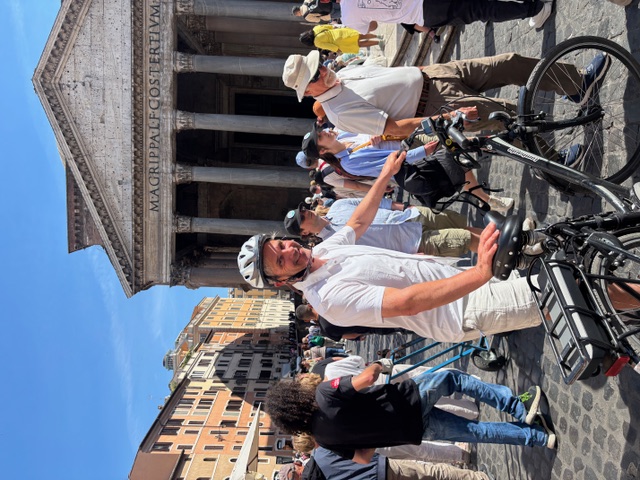
Now in Rome, which is fun, cosmopolitan, energetic and the May weather was exquisite. Walked four miles and electric biked another 15. I think the total tallies for my move-about - 1000 miles on a motorcycle (on and off road), 25 miles on an electric bike and about 40 miles walking around. All the above were done in a somewhat random fashion of having a destination but a bit variable on how to actually get there. The bicycling specifically was done without charting a course, which makes sense especially as it was electric-assisted, meaning you can make up time or ground whenever you decide. Walking that’s not true at all and when you want to be done, you actually don’t want to be 3 miles from home. Even motorbiking you can’t go hog wild without a direction since you can end up a 100 miles in the wrong direction before you know it. Biking without electric assist also has its limits since once you are tired, you are tired, and a hill is a hill.
Section E of Terminal 1 of the Rome Airport sends you through a curved gauntlet of a terminal, first leading you without escape through several Vegas-like brightly lit duty free shopping areas hawking everything but a postcard or Roma tourist stuff.
Rome was pretty, busy, entrepreneurial, hawkish. A new item I hadn’t seen before being sold at street level were small battery phone chargers, which was pretty genius - though getting a real one I guess is a challenge (mine works fine) and randomly plugging a street item into your phone seems somewhat hazardous - 1, the damage it could do to your phone and 2, the ability to hack your phone with location and data stealing seems like it should be a real concern. But not real enough not to be charged up.
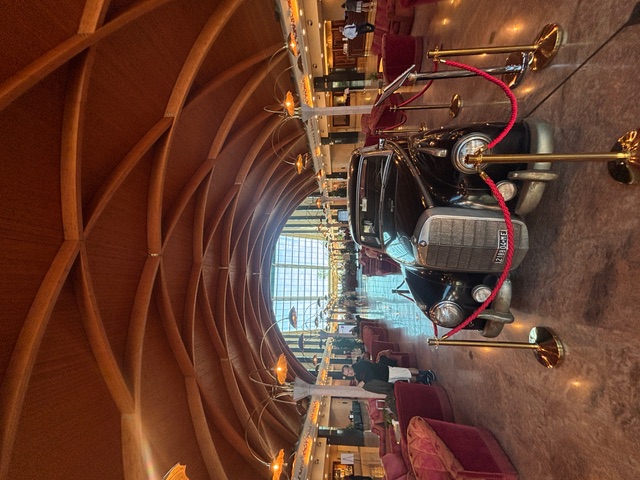
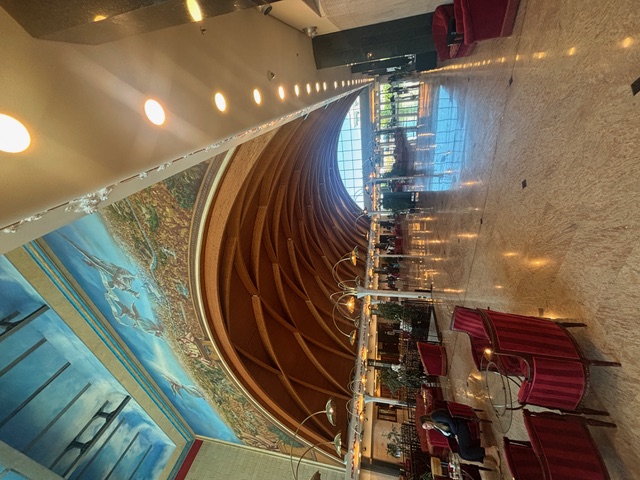
I’ve stayed in a lot of hotels, and even a fair share of airport hotels, but this Marriott mid-way between FCO (Rome airport) was an experience. The lobby was just gigantic, an open floor plan concept if there ever was one, with check-in, concierge, bar and big restaurant under the same giant frescoed roof. It was also a bit in the middle of nowhere, while still being central to both the airport and the city. Big chain hotel with a clear mission of keeping a large amount of guests well-spaced and comfortable.
I hate my Beats head phones. Either I have big ears, or I accidentally bought a kids set, or they are meant for someone different than me - but they hurt my ears. They weren’t cheap but they sit on my ears instead of over them like my Bose or Sony’s do. Makes no sense, which makes me think I’m missing something about them, since they are popular.
The Chatwal Lodge in Sullivan County in Chapin Estate is closing, with little notice or explanation. First the Dream Hotel bought it from founder Steve Dubrovsky and his partners if he had any at that time, and they seemed to have flipped it to Hyatt, who seemed to realized the water levels on the lake have been depressed for a decade or more, meaning not only do the homeowners look onto a moonscape of water level hope and consternation but any guests primary takeaway would be ‘wtf, where’s the water?’
Remarkably, to me, who has outlasted most of these better-funded projects with my real local knowledge, was that someone, especially smart hospitality owners, would have fallen in for the idea that this project had a chance to be vibrant. The salesmanship behind that would have been fun to see and probably involved a cowboy-owner wowing some Indians from the Sub-Continent (the Dream Hotel is from there I believe), taking advantage of their eager-beaver desire to be cool and American. By the time it sold in 2017, a friend in the know told me he thought the original founder was bouncing checks things had gotten so tight. And then wallah, a sale to a bunch a know-nothings - there’s always a sucker out there. But who knows, maybe I have no idea what I’m talking about, wouldn’t be the first time.
While they aren’t in contract yet, we are moving very quickly into contract on $2.5m of homes I was just talking about in previous posts that are some of the primary goals of this years business activities, plus another $800k of previously signed, finishing up projects. We had all year to get it done, and here it is in May - could be another one of those big big years that have become common-place, especially with the team I have in place right now, in the office and in the field. It just occurred to me as well, if these deals happen, I’ve put nearly $5m in deals together in the last 90 days between my spec homes and our ‘your land our homes’ program. Pretty serious accomplishment made possible by -wait for it - the team we have in the office and the field.

One thing for sure is bluetooth connection across all platforms is much improved - even hooking up my Beats to the business class entertainment system went off without much of a hitch, which is unheard of. Hotel radios, radios in rental car, etc… are becoming less of act of guesswork and hope and pray, and more of a ‘your connected’ exercise. That’s progress, even if Iphone voice text transcription is still a great example of the truism that monopolies stop improving as prices increase, be a railroad car in 1890, TV stations in the 70’s, Microsoft Windows, or the phone companies (Baby Bells) up until the early 80’s. Protected politically, risk adverse, and little incentive to push into new expensive unpredictable markets or products.
You hear all the time about the nature of food preservatives in the American food chain, and the lack of nutrition in our food and how much of our seemingly healthy food is really just a vacuous chemical-filled product with a distant relationship to real food. I ate a lot on this 3 week vacation, so if I haven’t put 10 lbs on, I am a live test case of how pure food, regardless of quantity, doesn’t cause obesity like fake food.

I love my transatlantic business class flights, though it appears I wasn’t mistaken when thinking the plane on the way over was an older model with seats that lacked the requisite cushioning. The A330-900 neo I’m on now, with 3 hour Avatar movie queued up on the entertainment screen. I’ve turned down the wine, champagne and cookies, and am settling into a comfortable flight - though, not be obnoxious, but being in the first row leaves me exposed to a little too much food and cabin activity right in front of me. Got my slippers ready, blankey nearby, and a host of Air Italy goodies in the goodie bag, including moisturizer, eye blinders, and some other items.
When I landed from Corsica to Rome, it was May 18th. That was a day a nationwide strike was underway to protest Israel’s genocide in Palestine, and now it seems other countries. Per the press release -
“Workers in two dozen cities had announced strike demonstrations on May 18, with additional solidarity protests launched throughout the day in response to Israel’s acts, leading to day-long mobilizations in many regions. USB emphasized the actions were in continuity with markings of Nakba Day during the weekend of May 15-16 and with a national demonstration against war and rearmament announced for Saturday, May 23.”
AI describes it as “The strike was organized following a call from the USB union and other civil society groups under the slogan "We block everything." Participants opposed rising living costs, increased military spending, and what they described as government priorities favoring armament over healthcare and education”.
Whatever the reason, I wasn’t aware of it and flew into the teeth of it Monday the 18th, with a lack of transportation from the airport, and hundreds if not thousands of people looking for ways out of the airport, as gridlocked traffic and strikes impacted the ability to get anywhere. Unaware of the strike and thinking waiting a few hours would be the trick (and not being in a hurry), I did just that, organizing some photos, etc…
When I went back outside, it was worse. I only had 10 miles to my hotel, but there was not a lot of options except for downtown Rome and even that was tough since there was the type of traffic leading into the airport that had people walking with their luggage scenario on the highways trying to make their flights.
So, I took matters into my own hands, and walked around with two crisp Benjamin Franklin’s until I found a taker, 4x the normal fee of my destination. I was in a car in about 3 minutes with a lot of wonderment on a lot of people. What did Tom Cruise’s sidekick say in that sports agent movie? - “Show me the Money”. The thing about traveling these days for me is that I’m not looking for a struggle from getting here to there - if going from Point A to Point B is painful, the whole trip will have lagging and negative impacts from the travel itself.
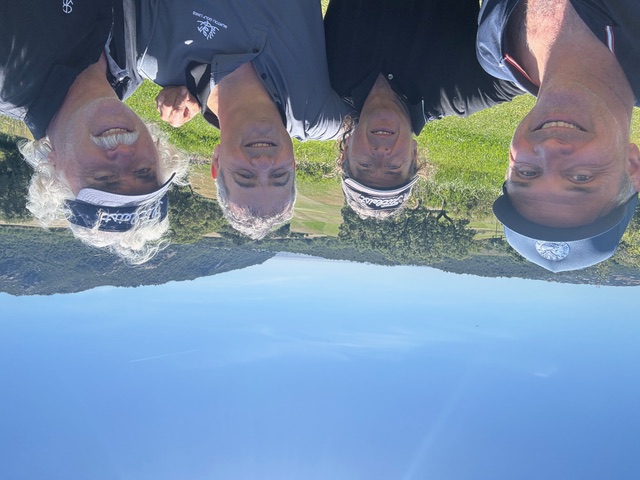
My 3 French golf partners.